
croit v2610.0: the croit Datacenter Manager, scheduled hook scripts and IP conflict detection
v2610.0 comes alongside the first release of the croit Datacenter Manager, one screen for all your croit and Ceph clusters. The croit release itself is smaller than usual: hook scripts can run on a schedule, and croit detects IP address conflicts on your networks. The release notes carry the full list of changes.
The croit Datacenter Manager
The croit Datacenter Manager is our new product for operators who run more than one cluster. It shows all your croit and Ceph clusters on one screen: their health, capacity and fill forecasts, logs and charts. It runs as one container next to your clusters and reads them through their API, with no agent to install. It has its own announcement, which tells the whole story.
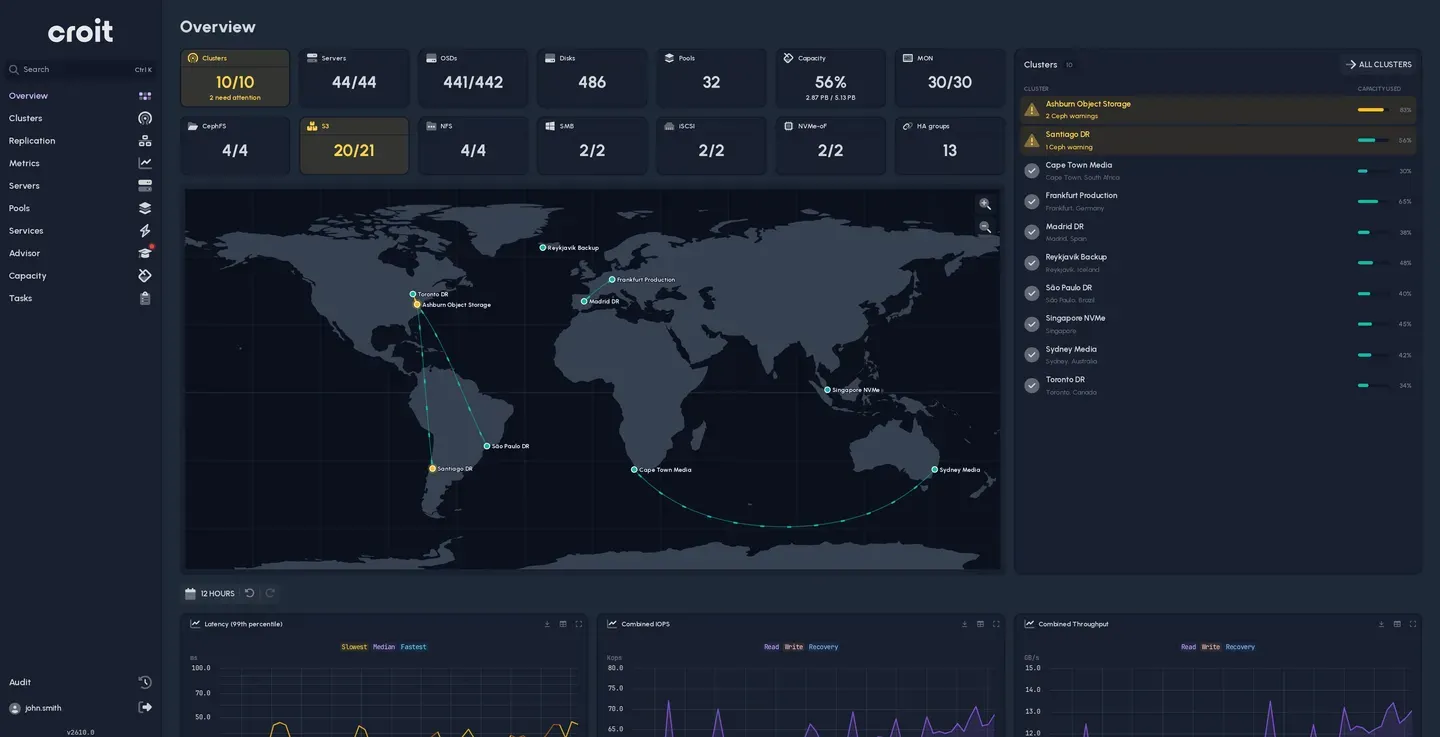
v2610.0 also contains a few improvements that make the Datacenter Manager work better with croit, most of them around S3 multisite: a cluster now reports its realm, zones and per-site sync details, and checks from its own servers whether another site's S3 endpoints are reachable before replication is set up.
Read the Datacenter Manager announcement →
Hook scripts can run on a schedule
A hook script is a shell script croit runs for you when something happens in the cluster: a server boots, a disk is formatted, the Ceph health changes. With v2610.0 a hook script can also run on a schedule, like a cron job, without waiting for an event. Pick the new CronSchedule event, set the schedule, and choose whether the script runs on the management node, on servers in the cluster, or on both.
That covers the jobs that used to need a cron entry set up by hand on each node: a nightly report, a cleanup, a check against an external system.
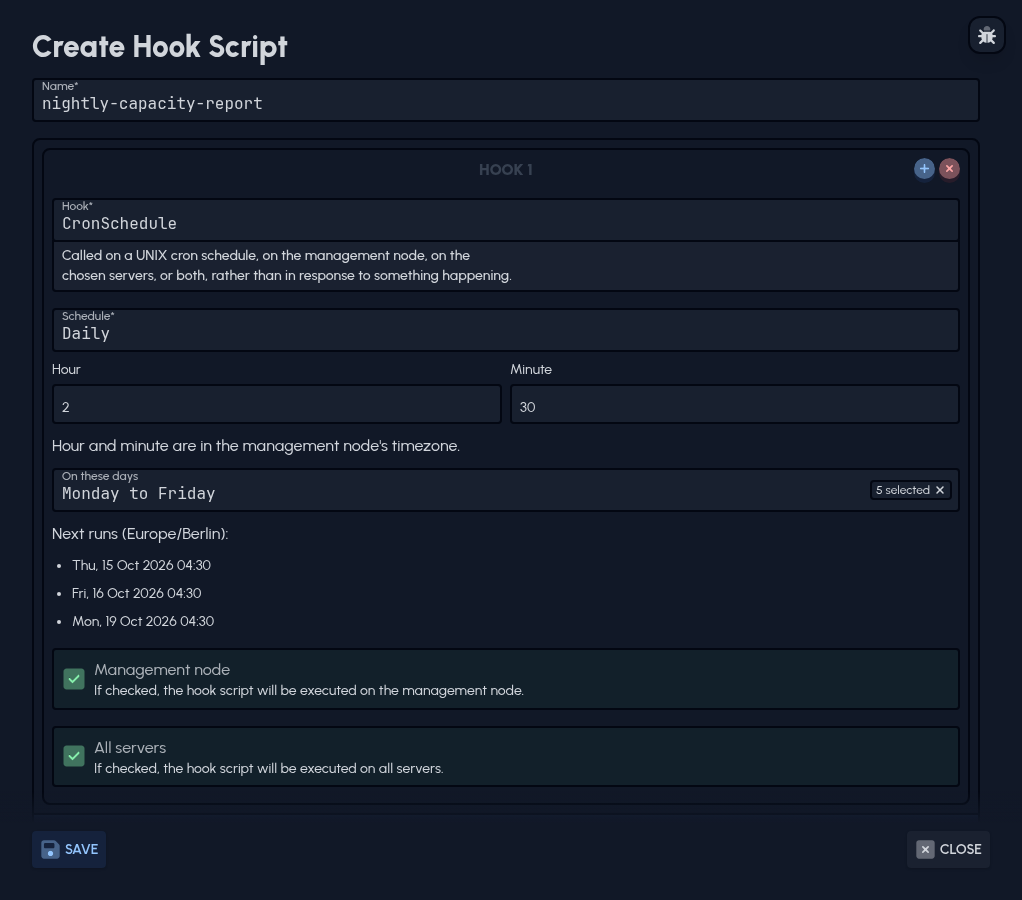
We also redesigned how you enter a schedule. Until now, a snapshot schedule was picked from a fixed list of predefined schedules, and anything else meant typing a Quartz cron string by hand, a dialect with a seconds field and its own rules that looks like cron and is not. Every schedule in croit now uses one picker instead: hook scripts, RBD and CephFS snapshot schedules, and automatic croit updates.
- Pick, don't type. Choose every few minutes, every few hours or daily, set the time, and limit it to certain weekdays. The selection reads as plain words, such as "Monday to Friday" or "All except Friday".
- See when it runs. Below the schedule, the picker lists the next runs in your own time zone, computed by the same scheduler that later runs the job, so daylight saving time is already taken into account. A schedule that would never fire, or an expression with a mistake, is flagged while you edit it, not after you save.
- Standard cron when you need it. Advanced takes any standard UNIX cron expression, the same syntax as a crontab, with a link to its reference.
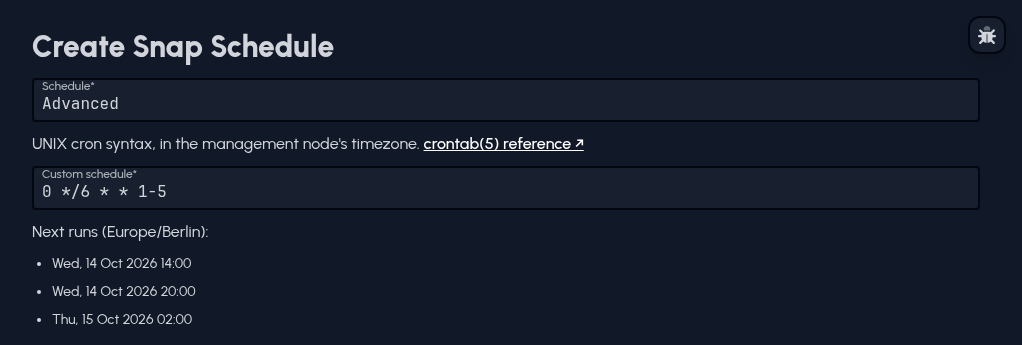
Snapshot schedules and automatic updates switch from Quartz cron to standard UNIX cron. croit converts your existing schedules during the update. Where a Quartz schedule has no exact UNIX equivalent, croit asks you to review it, with the converted schedule already filled in. If you set these schedules through the API, send UNIX cron from now on.
Learn more about hook scripts →
IP address conflicts are better detected
An IP conflict means two devices on the same network claim the same address. It rarely shows up as what it is: you see connections that reset at random, or SSH complaining that a host key changed. Finding the real cause can take hours.
croit now looks for these conflicts itself. Every minute, the servers probe the addresses croit configured on them: their NICs and VLANs, the management address, and the virtual IPs of HA groups, SMB and NFS gateways. When another device answers for one of them, croit raises a critical warning that names the address, the server and the other device, by hostname when it is a croit server and by MAC address otherwise. croit also probes a new address before it assigns one, and asks before it goes ahead when the address is already taken.
Security updates
v2610.0 updates croit's Go dependencies and the Go standard library. This fixes a high-severity denial-of-service vulnerability in HTTP/2 handling and several vulnerabilities in the standard library.
Also in this release
- croit no longer reverts a Ceph option it manages when you change it outside croit, for example with
ceph config setor the Ceph dashboard. - Servers stay online when croit's management IP address or port changes, instead of showing up as offline until they are rebooted.
- Ceph updates turn off
osd compact on startwhile the OSDs restart, so they come back faster, and restore your setting afterwards. - Adding an NFS export creates the CephFS directory it points at if it does not exist yet.
- The S3 multisite sync status is shown on the primary cluster too.
- Deleting an S3 bucket no longer stops after a timeout, which matters for very large buckets.
- croit refuses a pool compression blob size that is not a power of two, which Ceph accepts and which crashes OSDs as soon as they write incompressible data.
24/7 premium support
Running croit in production? Our team is available around the clock to help with upgrades, capacity planning and incidents.